
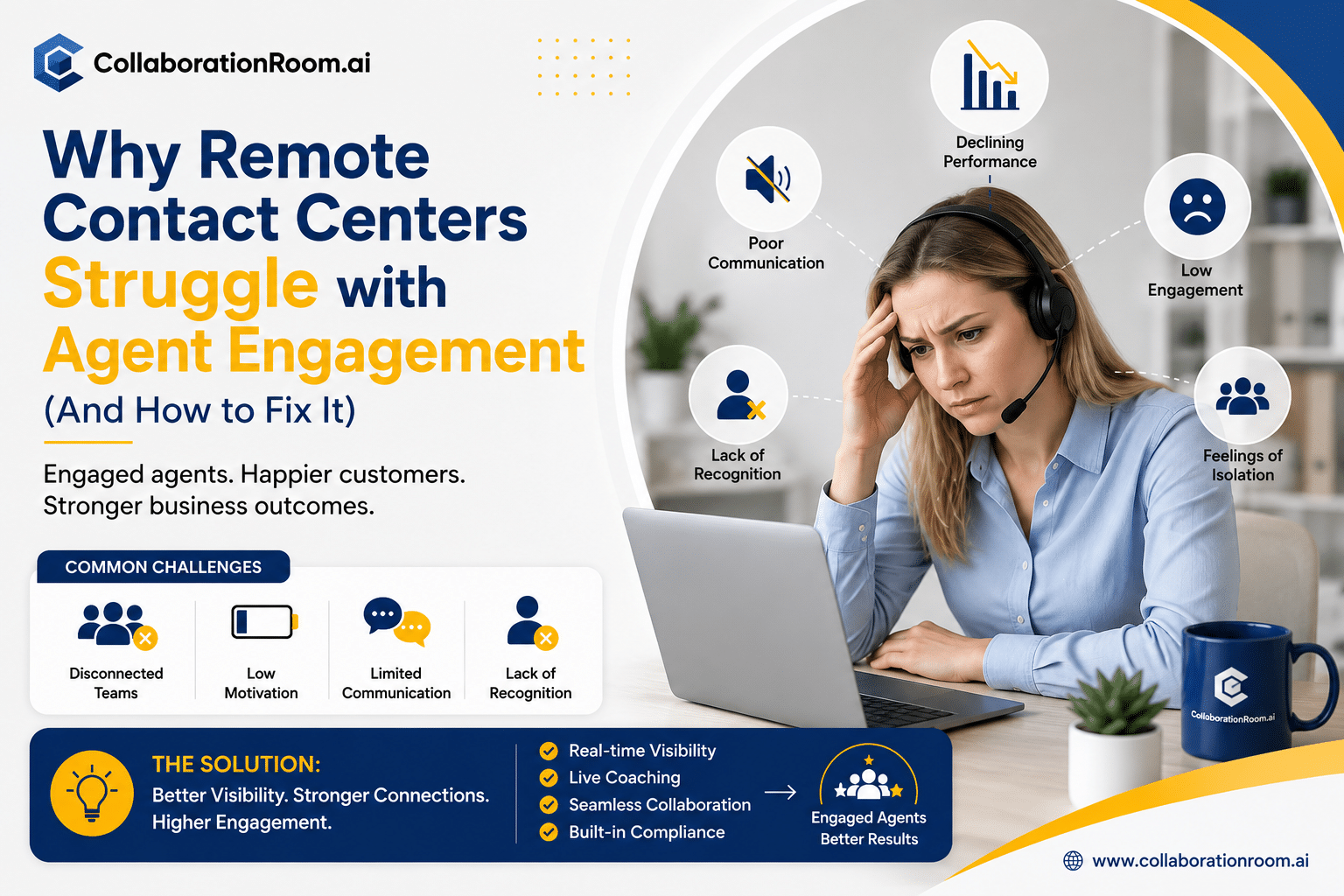
Remote and hybrid agent engagement has always been a challenge in contact centers. But when your team is spread across home offices, and possibly multiple continents, the problem gets harder to ignore. Missed coaching opportunities and unclear expectations can gradually affect performance, particularly when teams lack a shared workspace. And for most contact center leaders, the real question isn’t whether engagement is suffering, it is why and what to do about it.
The Visibility Problem
In a traditional contact center, a manager can walk the floor. They can hear how an agent handles an objection, notice when someone looks burnt out, or step in during a tough call. That physical proximity creates a natural feedback loop.
Remote work breaks that loop entirely. Without it, managers lose sight of what agents are actually doing during the workday.
- Are they on calls?
- Are they idle?
- Are they struggling with a specific type of customer?
- Do they need supervisor help?
Most teams rely on call logs and end-of-day reports to answer these questions, and that’s too slow to make a real difference.
This is where remote employee monitoring software becomes a practical tool rather than a surveillance measure. When implemented with transparency, it gives managers a live view of agent activity so they can coach in the moment, not after the fact.
Isolation Kills Motivation
Engagement isn’t just about performance metrics. It is also about how connected the agents feel to their team and their work. In an office, that connection happens naturally. At home, it has to be built intentionally.
Remote agents often report feeling invisible. They complete calls, hit their targets (or miss them), and rarely hear anything until a weekly review. That kind of silence is disengaging. People want to know how they are doing in real time, and they want to feel like someone cares.
Work from home monitoring software, when used as a coaching platform rather than a surveillance tool, can actually improve that dynamic. When agents know their screen activity is visible and managers use that data to offer timely feedback, the relationship shifts from reactive to collaborative.
The Coaching Gap
One of the clearest signs of low engagement is a lack of improvement over time. Agents who aren’t coached regularly tend to develop bad habits, plateau in performance, and eventually disengage entirely. For remote teams, coaching is often the first thing that gets deprioritized because it’s harder to do.
Scheduling a call to debrief on another call feels inefficient. And without real-time visibility into what agents are doing, managers don’t always know who needs help until a metric flags it.
Remote employee productivity monitoring software addresses this by surfacing activity data continuously, not just at report time. Managers can see which agents are handling high call volumes, which ones are spending too long in after-call work (and why!), and where patterns are breaking down. That data becomes the starting point for a coaching conversation, not the end of one.
Productivity Without Presence
A common misconception is that remote employees are less productive. Research consistently shows that’s not true, but it depends heavily on how the work is structured and supported. Without clear expectations and real-time feedback, remote employee productivity drifts.
Contact centers that monitor remote employee productivity effectively tend to share a few traits. They set daily targets that agents can see and track themselves. They use employee screen monitoring not to micromanage, but to identify friction, a slow CRM, too many manual steps, unclear scripts, and remove it. And they make performance data accessible to agents, not just managers.
When agents can see how they are performing in real time, they self-correct more often. That’s a meaningful shift from a culture where feedback only flows downward.
What Actually Fixes It
There’s no single answer, but the contact centers that get this right tend to focus on a few things:
- Continuous visibility, not periodic check-ins: Using remote employee productivity monitoring to stay connected to what’s happening in real time, not just at the end of the day.
- Real-time coaching triggers: Setting up alerts or flags that prompt a manager to step in when an agent is struggling, not after the call ends.
- Transparent monitoring practices: Agents who understand why they are being monitored and how that data is used are far more receptive to feedback, and far less likely to feel surveilled.
- Team presence tools: Platforms that replicate the feel of a shared floor, through continuous video, live status indicators, or collaborative dashboards, help reduce the isolation that drives disengagement.
- Agent-facing data: Giving agents access to their own performance data removes the dependency on manager feedback and builds a stronger sense of personal accountability.
Remote contact center engagement is more of a structural problem rather than being a people problem. When supervisors have limited visibility into day-to-day interactions, coaching becomes less immediate, and teams can begin to feel disconnected.
A shared virtual contact center floor brings supervisors and agents into the same workspace, making coaching, communication, and collaboration part of the everyday workflow. CollaborationRoom.ai was built to support that experience, helping remote and hybrid teams stay connected throughout the day.
If your agents are disengaged, the fix isn’t harder pressure. It’s a better structure.
Struggling with the same challenges in your remote contact center?
Schedule a call with us and see how CollaborationRoom.ai can help.
