
The Comfort of Stable Metrics
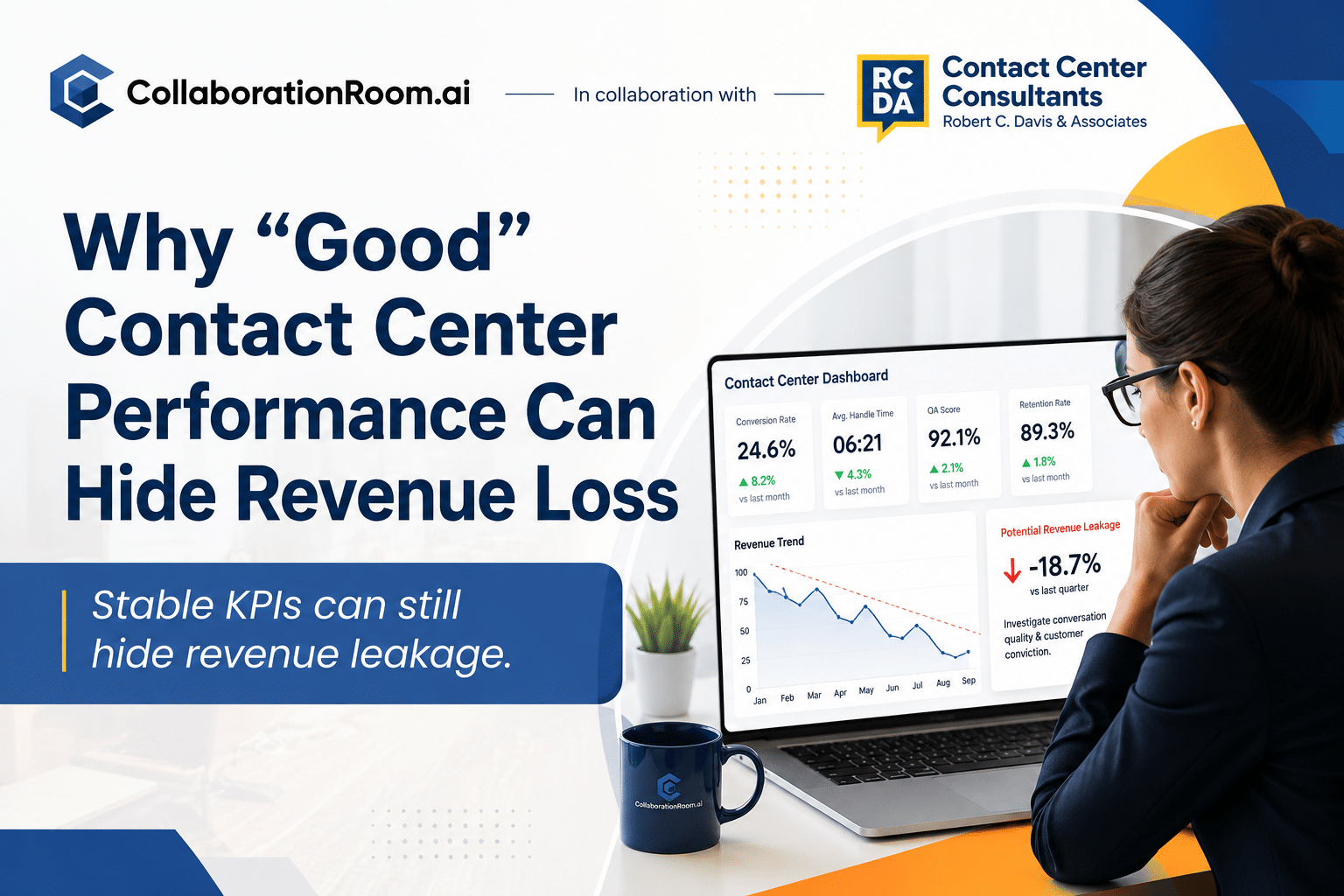
Most contact center operations are managed through dashboards. Conversion rates. Handle times. QA scores. Retention percentages.
When these numbers fall within expected ranges, the operation appears stable. Leadership feels confident. Forecasts seem reliable, but stability can be deceptive.
What looks like consistent performance is often a gradual decline—masked by metrics that were never designed to detect early-stage erosion.
What Traditional KPIs Don’t Capture
Standard KPIs measure activity and compliance. They do not fully capture economic impact.
They answer:
- Are processes being followed?
- Are targets being met?
They do not answer:
- Are customers truly convinced?
- Is long-term value being strengthened or weakened?
This gap is where revenue leakage begins.
As discussed by McKinsey, organizations that rely heavily on traditional KPIs often miss early indicators of declining customer engagement—signals that directly impact long-term revenue.
The Early Signs of Revenue Erosion
Revenue leakage starts quietly, inside conversations that appear “good enough.”
Common signals include:
- Customers agreeing without real conviction
- Retention saves that do not translate into loyalty
- Sales conversions with weaker downstream value
- Increased dependence on discounts or incentives
These patterns are difficult to detect through dashboards alone.
This is why firms like Robert C. Davis & Associates (RCDA) focus heavily on what they call the quality of the conversation—the moment where customer belief is either built or lost.
Activity vs. Outcome
A critical misconception in contact center environments is equating activity with performance.
More calls handled.
More interactions completed.
More “successful” outcomes logged.
But activity does not guarantee impact.
A conversation can be efficient, compliant, and still economically ineffective.
According to Forbes, organizations that fail to evaluate qualitative aspects of customer interactions can experience up to 20–30% erosion in customer lifetime value, even when operational metrics appear stable.
Why Leadership Often Sees It Too Late
Revenue decline is typically recognized only after it becomes financially visible.
By that point:
- The underlying issues have been present for months
- Customer behavior has already shifted
- Corrective actions become more complex and costly
In private equity-backed environments, this delay can directly impact valuation. Everest Group highlights that operational inefficiencies in CX can significantly affect EBITDA if not addressed early.
Detecting Leakage Where It Happens
To identify revenue leakage early, organizations must move closer to the source: conversations.
This requires focusing on:
- Depth of customer understanding
- Strength of objection handling
- Level of customer conviction
- Alignment between customer intent and outcome
These elements are less visible—but far more predictive of performance.
Building Visibility Into Conversation Quality
Organizations that successfully address revenue leakage invest in deeper visibility.
This includes:
- Analyzing real conversations, not just metrics
- Connecting frontline behavior to financial outcomes
- Defining what “high-quality” interactions actually look like
Combining this visibility with structured methodologies—such as those developed by RCDA—allows organizations to translate insight into measurable performance improvement.
The Strategic Advantage of Early Detection
Early detection changes the economics entirely.
Small improvements in conversation quality can:
- Increase conversion without increasing volume
- Improve retention without relying on discounts
- Strengthen long-term customer value
These are high-leverage adjustments, not large-scale transformations.
The Bottom Line
“Good performance” can be misleading.
The most important shifts in contact center environments happen beneath the surface—inside conversations that appear compliant but lack depth.
Organizations that combine conversation intelligence platforms like CollaborationRoom.ai with methodologies focused on conversation quality, like those from RCDA, gain a critical advantage.
They see earlier. They act faster. And they protect revenue before erosion becomes visible.
