
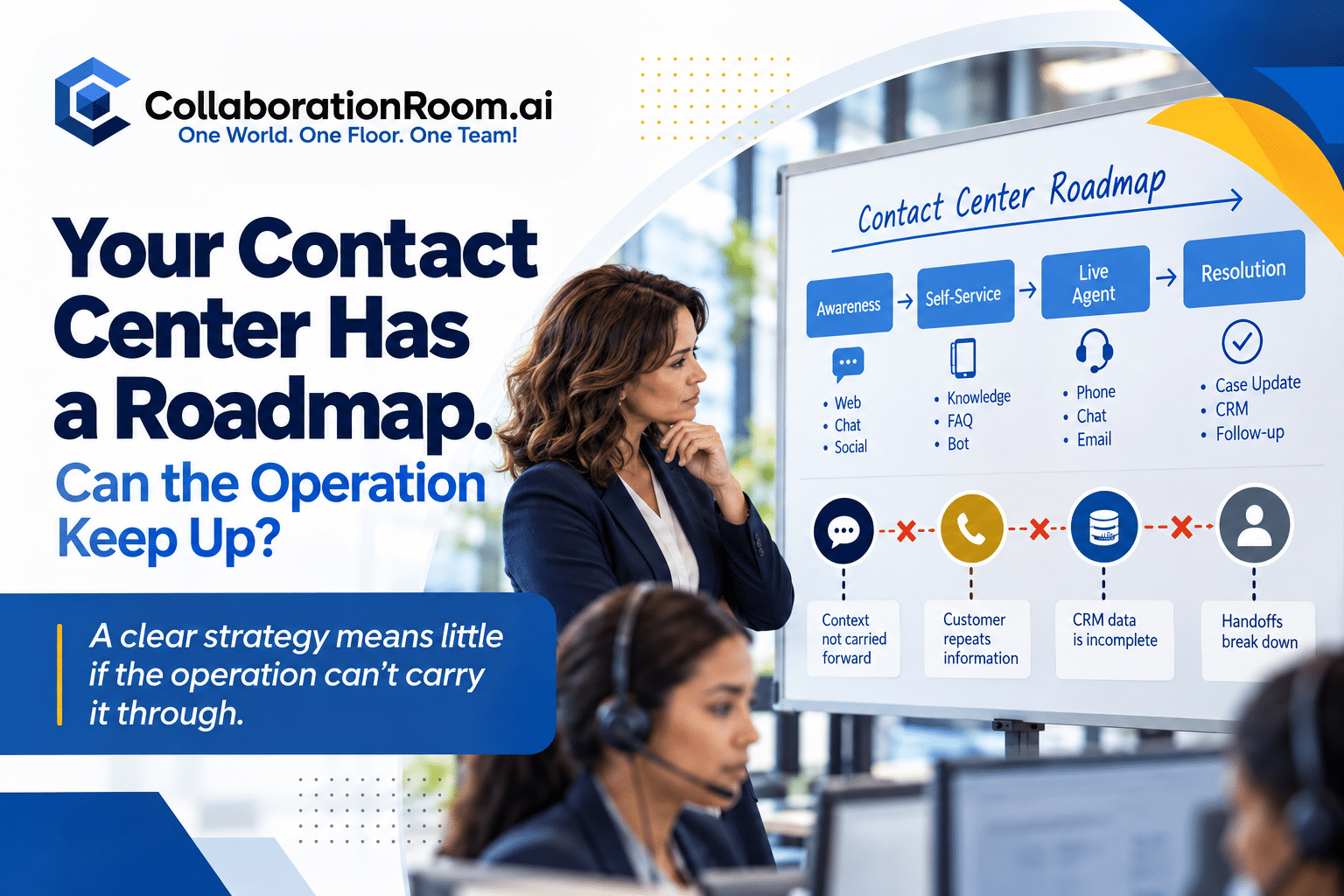
Your contact center strategy says the customer should be able to start in one channel, move to another, and keep going without starting over. Sounds reasonable, right? Then the customer starts digitally, gets stuck, and calls. The agent gets the customer, but not enough of the context that came before it. Now the customer is explaining the problem again while the agent searches for information that should have followed them into the conversation.
The roadmap certainly didn’t say, “Make the customer repeat everything.” The operation just couldn’t carry the strategy all the way through.
A 2026 contact center maturity benchmark from SuccessKPI surveyed 400 contact center leaders in May and June. CMSWire Insights partnered with SuccessKPI on the benchmark, and CMSWire Studio later discussed the findings in sponsored content. Of the seven areas evaluated, strategy was the most mature. Among the least mature were CX, channels and automation; real-time intelligence and agent assistance; and reporting, measurement and value realization. So, a lot of contact centers know where they want to go. The harder part is getting the operation to work that way every day.
Your roadmap doesn’t move the customer contextYour roadmap doesn’t move the customer context
Let’s start with the customer. The SuccessKPI/CMSWire research points to backend integration and disconnected systems as reasons contact centers can end up with delays and disjointed experiences. One of the easiest ways to see that problem is when the customer has to repeat information because the context did not move with them.
The customer does not care which platform owns the information. They do not care where one system stopped talking to another. They just know they already told you this.
Follow a few real customer journeys. Pick several common interactions and walk them all the way through. What happens when someone moves from one channel to another? What information comes with them? What disappears? Where does the agent have to go looking for something the customer already provided?
That gives you a much more useful question than simply asking whether you have an omnichannel strategy: When the customer moves, does their context move with them?
If it doesn’t, you may have a mature strategy sitting on top of an operation that is not ready to execute all of it yet.
The right information has to show up while it still mattershas to show up while it still matters
The same problem shows up on the agent side. You can give an agent a lot of technology and still make them search for the answer while the customer waits.
The benchmark identified real-time intelligence and agent assistance as another less mature area. CMSWire’s sponsored summary also notes that organizations can struggle to provide information to agents dynamically and proactively enough. That should matter to every contact center leader because your agent doesn’t just need access to information. They need the right information while they can still use it.
Watch what actually reaches the agent. When an interaction gets complicated, can the agent find what they need quickly enough to keep the conversation moving? Does useful information show up in context, or are they searching through different places trying to piece the answer together?
If the answer technically exists somewhere in your operation but the agent cannot get to it when the customer needs it, how much good is it doing?
Do not confuse access with usefulness. There is a big difference between saying, “The information is available,” and having that information available at the point where the agent can actually do something with it.
You don’t need another strategy meeting to answer these questions. Go look at what happens during the interaction.
Your systems still have to talk to each otherhave to talk to each other
Most contact centers are not working from a clean sheet of paper. You have existing systems, newer systems, information sitting in different places, and channels that may have been added at different times. Somehow, all of that still has to work together well enough for the customer and the agent.
That does not mean the strategy is wrong. It means the roadmap is only one part of the job.
Ask what the technology was supposed to improve. Reporting, measurement and value realization were also among the less mature areas in the SuccessKPI benchmark. That one is worth paying attention to because technology was added for a reason.
Can you tell whether it is doing what you expected?
Did customer context become easier to carry across the journey? Are agents getting useful information sooner? Can your leadership team tell whether the technology is actually helping the operation do what the roadmap says it should do?
You do not need one magic ROI number for everything. You do need to know whether the problem you spent money to solve is getting better.
The roadmap still has to work on the floorhas to work on the floor
Now, before you think I’m about to tell you CollaborationRoom.ai fixes your CRM integrations, I’m not. That is not what we do.
If your CRM, routing, channels, data, or reporting architecture are not carrying information correctly, those issues need to be addressed in those parts of the operation.
CollaborationRoom.ai plays a different role. Its Virtual Floor is built around the operating environment where supervisors, trainers, and agents are doing the work. It gives leaders a live environment for supervisor presence and support, coaching, training and nesting, engagement, production, and operational visibility across distributed contact center operations.
That matters because even after the strategy is clear and the right systems are in place, somebody still has to run the operation. Supervisors still need to be available. Trainers still need to work with people moving from training into production. Agents still need support. Leaders still need enough context to understand what is happening while it is happening.
Because the roadmap belongs to leadership, but eventually the customer and the agent have to live inside it.
A good strategy tells you where you want to go. Your systems, information, and operating environment determine whether you can actually get there.
So, the real question is not whether your contact center has a roadmap. Can your contact center actually run it?
If your strategy is clear but the operating environment still feels disconnected, it may be time to look at how your supervisors, trainers, and agents are working together day to day.
If you want to see what CollaborationRoom.ai’s Virtual Floor looks like in practice,
